
.com vs Country-Specific Domains: Which Should You Choose?

It's one of the first branding decisions for any online business: the global default .com, or a country-code domain (ccTLD) like .de, .co.uk, .ae, or .ir? Both are legitimate choices — they just optimize for different things.
First, what is a ccTLD — and what is .com instead?
A ccTLD (country-code top-level domain) is a two-letter domain extension assigned to a specific country or territory. The two letters are not arbitrary: they come from the ISO 3166-1 alpha-2 country-code standard, and every delegation is listed in IANA’s Root Zone Database, which is why Germany gets .de, the United Kingdom .uk, Canada .ca, and the United Arab Emirates .ae. Each ccTLD is delegated by IANA to a national registry that sets its own rules and prices. So yes — a ccTLD is a country domain by definition; that is the whole point of the category.
.com is the opposite kind of thing. It is a generic top-level domain (gTLD), not a country code, so the common question “which country is .com?” has a clean answer: none. It is geographically neutral. .com is operated as a single global registry by Verisign under an ICANN contract — Verisign operates the authoritative registry for .com and .net and reports providing routing support for over 179 million .com and .net domain names — and none of those registrations carries a built-in tie to any one country. When people hear a brand and type brand.com by reflex, they are relying on exactly that neutrality.
Hold those two definitions side by side and most of the decision falls out of them: a ccTLD says “this site is for this country”; a .com says “this site is for everyone.”
What search engines actually do with them
This is where most myths live, so let's be precise:
- A ccTLD is a strong geo-targeting signal. In its own documentation on managing multi-regional sites, Google says a ccTLD is “tied to a specific country… and therefore provide[s] a strong signal to both users and search engines that your site is explicitly intended for a certain country.” That helps you rank locally — and quietly limits you everywhere else.
- A .com is geographically neutral. You reach specific countries through localized content,
hreflangtags, server and link signals, and a local business presence — but nothing is baked in. (Note: Google removed the Search Console country-targeting setting for gTLDs in September 2022, so the old “set your target country in Search Console” advice no longer applies; geographic relevance is now inferred from the signals above.) - Neither gets an inherent “quality bonus.” A great .com and a great ccTLD rank equally well for their intended audience.
There is an important exception. Google treats a handful of ccTLDs as generic because people use them that way, so they carry no country targeting at all. Google's current list is: .ad, .ai, .as, .bz, .cc, .cd, .co, .dj, .fm, .io, .la, .me, .ms, .nu, .sc, .sr, .su, .tv, .tk, .ws. If you buy .io or .co expecting a home-country ranking boost, you won't get one — Google reads them the same way it reads .com.
The trust factor
Users bring their own biases:
- In many countries, a local domain signals “this business is really here” — local support, local currency, local law. For domestic e-commerce, a familiar national extension often reads as more trustworthy than an unfamiliar global one.
- Internationally, .com signals an established, global operation, and it's what people type by reflex. If someone hears your brand on a podcast, they'll try brand.com first.
.com vs ccTLD at a glance
| Factor | ccTLD (.de, .co.uk, .ca…) | .com (gTLD) |
|---|---|---|
| Tied to a country? | Yes — via ISO 3166-1 alpha-2 | No — geographically neutral |
| Google geo-targeting | Strong, built-in, to one country | Neutral; earned via hreflang & content |
| Who runs it / rules | National registry; rules vary by country | Verisign under ICANN; uniform worldwide |
| Local presence required? | Sometimes (.ca, .au, .fr, .de have rules) | No |
| Best for | A genuinely local business or audience | Global or multi-country ambitions |
| Reach beyond home market | Limited by the country signal | Unlimited by default |
Practical differences that bite later
- Registration requirements: some ccTLDs demand a local connection. Canada's registry (CIRA) enforces Canadian Presence Requirements for .ca; France's AFNIC requires a registrant based in the EU (or Norway, Iceland, Liechtenstein or Switzerland) for .fr; Australia's auDA expects an Australian presence such as an ABN for .au; and Germany’s DENIC requires the holder to name an administrative contact with an address in Germany for .de. Each rule comes from that registry’s own eligibility policy and they do change, so confirm the current text at the registry before you commit. Where you can't meet the rule yourself, registries and registrars often offer a trustee (local-presence) service — a real, recurring cost and dependency to factor in. Check before you commit.
- Pricing and policy: ccTLD prices and dispute rules are set by national registries and vary widely; .com is cheap, stable, and governed by well-known ICANN processes (including the UDRP for disputes).
- Expansion: a brand built on .co.uk that later goes global usually ends up buying the .com anyway — at whatever price its current owner demands.
If a local ccTLD is your plan, the requirements and paperwork are worth walking through in advance — our step-by-step guide to registering an international domain covers the presence checks and documentation country by country.
A simple decision framework
- Local business, local customers (restaurant, clinic, regional shop): the ccTLD is the natural choice — local trust and local SEO are exactly what you need.
- Global or ambiguous audience (SaaS, content, e-commerce with international shipping): take the .com.
- Serious about one market now, global later: register both on day one. Use one as primary, 301-redirect the other. The second domain costs less than a pizza per year; buying it back later can cost thousands.
If you go multi-country
Growing brands eventually face the ccTLD-per-country vs. one-.com-with-subfolders question. Google's own guidance frames the trade-off cleanly: a country-specific domain gives “clear geo-targeting” and makes server location irrelevant, but it is expensive and can only target a single country, whereas subdirectories on one gTLD (example.com/de/) are easy to set up and cheap to maintain on a single host. That is why many practitioners default to one .com with subfolders — it consolidates authority into one domain and is far simpler to run — reserving separate ccTLDs for markets where a local presence is a legal or commercial requirement. Be clear whose view that is, though: Google’s own multi-regional guidance lists the trade-offs and stops short of recommending any one structure. It also names two things the subfolder route costs you — a single server location for every market, and a URL that does not visibly signal which country it is for — and it lists a third option this comparison has so far ignored: subdomains on a gTLD (de.example.com), which sit between the two on both effort and clarity. You can compare that infrastructure decision alongside your domain and hosting setup so the two don't fight each other.
Bottom line
Choose based on where your customers are, not on fashion: a ccTLD for a genuinely local business, .com for anything with global ambitions — and when in doubt, secure both and decide with redirects rather than regrets.
Sources
- Manage multi-regional and multilingual sites — Google Search Central (unknown)
- IANA Root Zone Database (ccTLDs and ISO 3166-1) (unknown)
- Verisign as a Domain Registry (.com / .net operator) (unknown)
- The International Targeting report is deprecated — Search Console Help (2022-08)
Frequently asked questions
Is .com a country domain?
No. .com is a generic top-level domain (gTLD) with no country attached. It is operated globally by Verisign under an ICANN contract, so it is treated as geographically neutral rather than tied to any nation.
What is a ccTLD?
A country-code top-level domain: a two-letter extension assigned to a country or territory from the ISO 3166-1 alpha-2 standard — for example .de (Germany), .uk (United Kingdom) or .ca (Canada). Each is run by a national registry with its own rules.
Does a ccTLD help my SEO?
It helps you rank in that one country because Google reads it as a strong geo-targeting signal, but it can limit visibility elsewhere. Exceptions like .io, .co and .tv are treated as generic by Google and carry no country boost.
Should I buy both the ccTLD and the .com?
If you're serious about a local market now but may expand later, yes — register both on day one, run one as primary, and 301-redirect the other. Buying the missing domain back after someone else takes it can cost far more than holding it.
Related reading
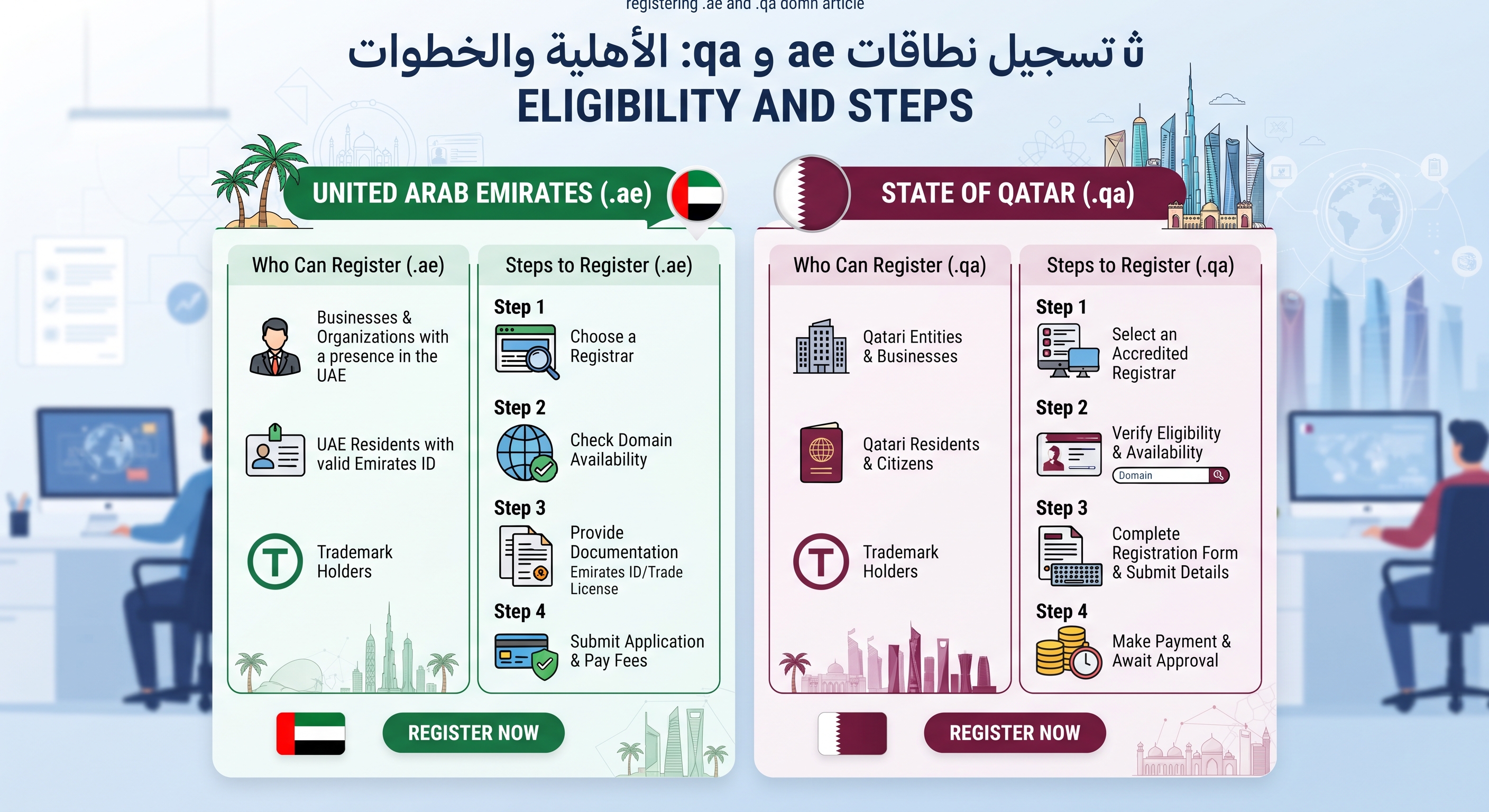
Registering .ae and .qa domains: eligibility and steps
The .ae and .qa spaces are run by regulators with written eligibility rules, and some extensions are closed to anyone without a local licence. Here is who can register .ae, .co.ae, .net.ae and .qa, what documents are needed, and how renewal works.
Read more →
How to Register an International Domain (Step-by-Step)
"International domain" means four different things, and only one of them is what most people actually want. This guide separates a globally available generic TLD from an internationalized (non-Latin) name, the treaty-only .int domain, and running your own TLD — then walks the registration for each with the real 2026 costs.
Read more →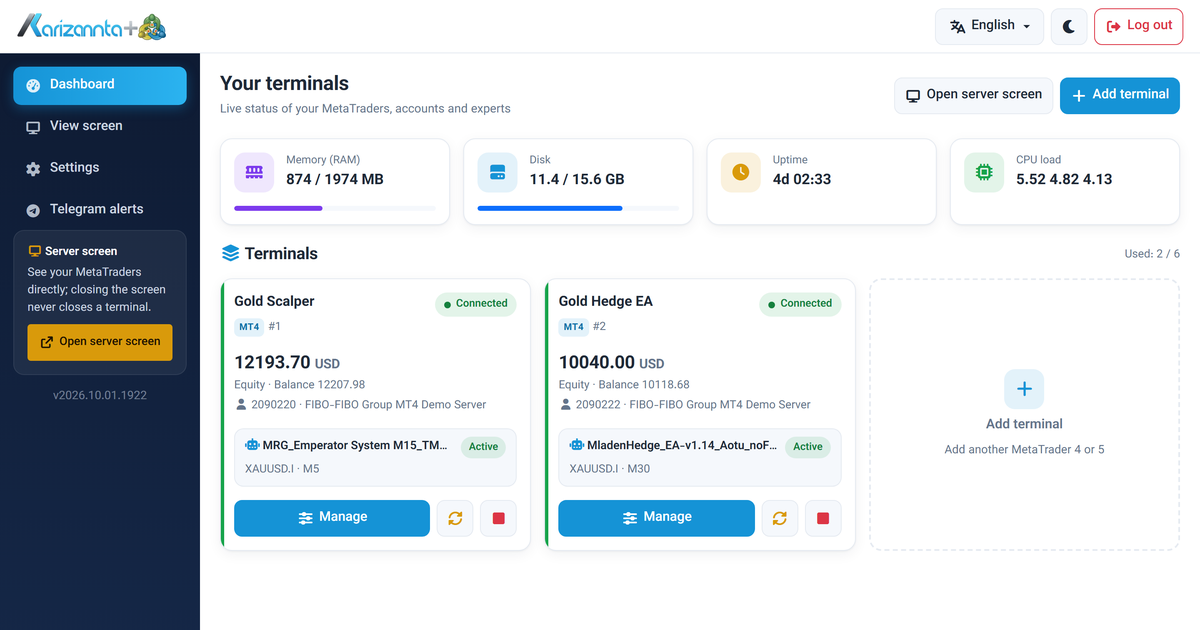
MetaTrader VPS on Linux: Run MT4 and MT5 Expert Advisors 24/7
A MetaTrader VPS that keeps MT4 and MT5 running on its own: automatic re-login after every restart, a web panel for accounts and expert advisors, and Telegram alerts. A tour with screenshots.
Read more →