
Netherlands VPS: what AMS-IX and DE-CIX peering does for latency
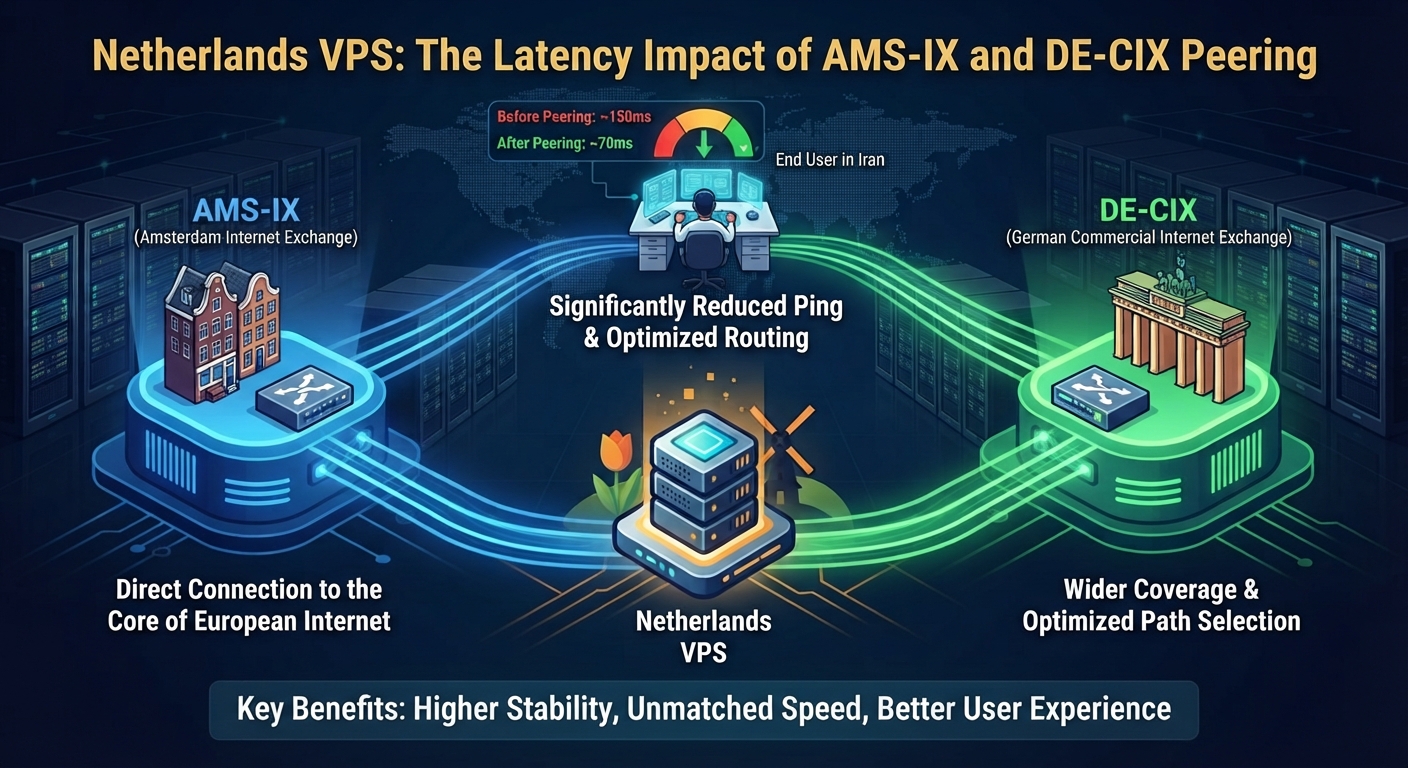
You are looking at a European target market and a server that answers a little slower than it should. Pings sit at 30 to 60 ms across the continent, and worse, they wobble. A synchronous API call or a database replica feels that jitter more than a static page ever will. The location field on the order form says something, and you want to know whether "peered into AMS-IX and DE-CIX" is a real network fact or a line on a spec sheet.
It is a real fact, and it has limits. Here is what peering into those exchanges does to a packet, how to read it in a traceroute, and the honest rule for who should host in the Netherlands and who should not.
What "peered into AMS-IX and DE-CIX" actually means
Karizanta's Netherlands servers sit in Naaldwijk, just south of The Hague. They are not on our own hardware; the upstream network there is peered into AMS-IX in Amsterdam and into DE-CIX. That distinction matters for how you read the rest of this page. We are describing a network position, not a rack we own.
An internet exchange is a shared switching fabric in a set of data centres where many networks meet and hand traffic to each other directly. Two ways exist for your packets to reach another network. One is transit: you pay an upstream carrier to deliver traffic to the rest of the internet, and they route it through their backbone, often via one or two other carriers. The other is peering: your upstream connects to the destination network on the exchange fabric and hands the packet over in one step, no middle carrier.
Peering removes carriers from the path. Fewer networks in the middle means fewer router hops, fewer congestion points, and usually a shorter physical route. That is where the latency win comes from. It is geometry and hop count, not magic.
The benefit is real when the other end is also on, or close to, the same exchange. A Dutch VPS reaching a German ISP, a French cloud region or a UK content network over AMS-IX or DE-CIX takes a short, direct path. The same VPS reaching a host in Singapore still crosses oceans of transit, and peering in Amsterdam does almost nothing for it. Keep that in mind for the who-should-choose-it section.
What the exchange figures tell you
The value of an exchange is the number of networks you can reach across it without paying transit. More connected networks means more destinations one hop away. Both exchanges publish their own numbers.
| ExchangeConnected networksPeak trafficSource and date | |||
| AMS-IX (Amsterdam) | 902 connected parties (911 ASNs shown live) | 15.095 Tbit/s peak, 15 April 2026 | AMS-IX 2025 Facts & Figures, published 2 Feb 2026; peak announced 17 Apr 2026 |
| DE-CIX Frankfurt | "more than 1,000" networks | "more than 18 Terabit per second" peak | DE-CIX Frankfurt location page (DE-CIX's own figures) |
Read those figures for what they are: reach and scale, not a latency guarantee. DE-CIX's 2024 annual report (published 6 May 2025) put more than 4,000 networks connected across its global platforms, up 10% on the prior year, with 170 Tbit/s of connected customer capacity. The Frankfurt "more than 18 Tbit/s" and "more than 1,000 networks" come from DE-CIX's own Frankfurt page, so treat them as vendor-stated rather than independently audited. What they establish is simple. The major European ISPs, mobile carriers and cloud on-ramps are present at these exchanges, so a network peered into them can reach most of European end-user traffic without going through a transit backbone first.
Reading it in a traceroute: peered path versus transit path
The difference shows up in the path, not just the final number. Below are two illustrative traceroutes from a Netherlands VPS to the same European destination, one taking a peered path and one forced onto transit. IPs are RFC 5737 documentation addresses, so nothing here points at a live host.
Peered path, via the exchange fabric:
- 1 203.0.113.1 (VPS gateway, Naaldwijk) 0.3 ms
- 2 192.0.2.1 (provider edge) 0.6 ms
- 3 192.0.2.130 (exchange fabric, Amsterdam) 1.9 ms
- 4 198.51.100.1 (destination ISP border) 2.4 ms
- 5 198.51.100.20 (target host) 2.6 ms
Transit path, same destination, routed through carriers:
- 1 203.0.113.1 (VPS gateway, Naaldwijk) 0.3 ms
- 2 192.0.2.1 (provider edge) 0.6 ms
- 3 192.0.2.65 (transit provider PoP) 3.2 ms
- 4 192.0.2.66 (transit backbone) 9.1 ms
- 5 192.0.2.90 (second transit backbone) 12.7 ms
- 6 198.51.100.200 (destination transit border) 15.4 ms
- 7 198.51.100.1 (destination ISP border) 17.9 ms
- 8 198.51.100.20 (target host) 18.8 ms
Two things to read here. First, hop count: five versus eight. Every extra hop is another router that can queue your packet under load. Second, look at where the time is added. On the peered path the jump to the destination network happens at hop 3, on the exchange, and the number barely moves after that. On the transit path the milliseconds accrue across hops 4 to 6, inside carrier backbones you do not control. That is the mechanism behind "steadier" latency. Fewer independent networks in the path means fewer places for congestion and re-routing to add jitter.
When you evaluate the Netherlands VPS, run mtr or traceroute from a real Dutch host to your own users' networks and count the hops and the point where the path leaves for a foreign backbone. If your key destinations resolve in three or four hops through an Amsterdam exchange, the peering is doing its job. This is the exact benefit a Netherlands VPS in Naaldwijk is positioned for: short, direct paths into European networks rather than a long haul across someone's transit core.
Who should choose the Netherlands, and who should not
The peering only pays off if your traffic ends near the exchange. APNIC made this point bluntly in an August 2026 panel write-up: an exchange helps when the content the user wants is hosted locally, and helps little when it sits on another continent. Their example was Pakistan, where local peering did little because most content was overseas, versus Australia, where local hosting kept traffic in-region and cut latency. The lesson transfers directly.
Choose the Netherlands when:
- Your audience is in mainland Europe: Germany, the Benelux, France, Austria, Poland, Italy and neighbours.
- You want EU-based hosting but outside the Nordics.
- Your workload talks to European ISPs, mobile networks or nearby cloud regions, where the peered path stays short.
- Round-trip time and jitter to European users matter to the app: real-time APIs, game or voice backends, database replicas.
Do not choose the Netherlands when:
- Most of your users are in the UK. Coventry sits closer to them; a UK VPS in Coventry on our own hardware will usually win on domestic round-trip.
- Your audience or your other systems are concentrated in the Nordics or the Baltic. A Sweden VPS in Stockholm gives a shorter path there.
- Your traffic is mostly intercontinental. Peering in Amsterdam does not shorten a path to Asia or South America; you are paying for reach you will not use.
One caveat worth stating plainly. Peering shortens the path and steadies it; it does not lower the speed of light. Amsterdam to Milan is roughly 1,000 km each way, so a best-case round trip is bounded by physics no matter how few hops you have. Peering removes the avoidable delay, the carrier detours and queue time. It cannot remove distance.
Where to run this
If your users cluster in mainland Europe and you want EU hosting off the Nordic axis, a Netherlands VPS in Naaldwijk is the right pick: peered into AMS-IX and DE-CIX for short paths to European networks, deployed in under 60 seconds, with IPv4 and IPv6 and always-on DDoS filtering on every plan. Before you commit, do the ten-minute test. Trace from a Dutch host to the networks your users actually sit on, count the hops, and see where the path leaves for foreign transit. If it stays short, the exchange is earning its place in the path. If your audience is really in Coventry's or Stockholm's backyard, pick that location instead and skip the detour.
Sources
- 2025 Facts & Figures: Capacity and Traffic Growth — AMS-IX (2026-02)
- AMS-IX hits new traffic peak at 15 Terabit per second (2026-04)
- DE-CIX Frankfurt — connect to the world's leading IX (unknown)
- DE-CIX Annual Report: record-breaking traffic peaks and a 10% increase in global network connections (2025-05)
- Do IXPs make the Internet faster? It's complicated — APNIC Blog (2026-08)
- Peering and IXPs: Building an Affordable and Reliable Internet — Internet Society (unknown)
Frequently asked questions
Does a Netherlands VPS peered into AMS-IX guarantee lower latency for my users?
No. Peering shortens and steadies the path when your users' networks are also at or near the exchange, which covers most of mainland Europe. If your audience is intercontinental, the packet still crosses transit and peering in Amsterdam barely helps. Test with a traceroute to your real user networks before deciding.
What is the difference between peering and transit in plain terms?
Transit means paying a carrier to carry your traffic to the rest of the internet, often through one or two more carriers. Peering means your network hands the packet directly to the destination network on a shared exchange fabric, with no carrier in the middle. Peering removes hops, which usually lowers latency and jitter.
How many networks can I reach over AMS-IX and DE-CIX?
AMS-IX reported 902 connected parties in its 2025 Facts & Figures (published February 2026). DE-CIX's Frankfurt page states more than 1,000 connected networks. Those numbers are reach, not a latency promise: they mean most European ISPs and cloud on-ramps are one peered hop away.
Should I pick the Netherlands or the UK for a European audience?
For users concentrated in the UK, Coventry gives a shorter domestic round trip. For mainland Europe outside the Nordics, the Naaldwijk servers peered into AMS-IX and DE-CIX give shorter paths to continental ISPs and clouds. Match the location to where most of your traffic ends.
How do I check whether the peering actually helps my traffic?
Run mtr or traceroute from a Dutch host to the networks your users sit on. Count the hops and note where the path leaves for a foreign transit backbone. If key destinations resolve in three or four hops through an Amsterdam exchange, the peering is working. If the path immediately jumps to a distant carrier, the benefit is small for you.
Related reading
MetaTrader VPS on Linux: Run MT4 and MT5 Expert Advisors 24/7
A MetaTrader VPS that keeps MT4 and MT5 running on its own: automatic re-login after every restart, a web panel for accounts and expert advisors, and Telegram alerts. A tour with screenshots.
Read more →
Self-host n8n on a VPS with Docker and Postgres
A complete, copy-pasteable path to run n8n on your own Ubuntu VPS with Docker Compose and Postgres: the environment variables that matter, nginx and TLS, and the webhook, timezone and queue-mode traps that catch everyone.
Read more →
Self-host Vaultwarden on a VPS: the secure setup
A copy-pasteable path to run Vaultwarden 1.37.3 behind nginx and TLS on a small VPS, with the security steps that matter: admin token hashing, closed signups, a WebSocket-aware proxy, fail2ban on the login endpoint, and a backup you have actually restored.
Read more →